

A Strategic Analysis of Post-Sale Discounts Under GST
Executive Summary
The Central Board of Indirect Taxes and Customs (CBIC), through Circular No.
251/08/2025-GST dated September 12, 2025, has introduced a landmark clarification on
the Goods and Services Tax (GST) treatment of secondary and post-sale discounts. This
directive represents a significant maturation in GST policy, moving away from previously
contentious and administratively burdensome positions towards a more pragmatic and
legally sound framework. The circular provides definitive guidance on three core areas of
dispute: the non-reversal of Input Tax Credit (ITC) on discounts settled via financial or
commercial credit notes; a nuanced test for treating discounts as consideration for a
dealer’s onward supply; and a “bright line” distinction between non-taxable trade
incentives and taxable promotional services.
While the circular brings welcome clarity and is poised to reduce litigation, its subtext
reveals a critical shift in the compliance landscape. The burden of proof now rests
squarely on the taxpayer, necessitating robust documentation and contractual precision.
This report uncovers these hidden implications, highlighting how the circular transforms
the issuance of credit notes into a strategic commercial decision and elevates the
importance of meticulously drafted agreements. The analysis concludes that Circular No.
251, while resolving long-standing ambiguities, demands a proactive strategic
realignment of commercial contracts, accounting practices, and internal financial
controls for businesses to navigate the new compliance paradigm effectively.
Anatomy of Circular No. 251/08/2025-GST
The circular meticulously dissects three primary areas of ambiguity that have historically
plagued taxpayers and tax authorities alike. It provides clear, scenario-based
clarifications that are anchored in the legal provisions of the CGST Act, 2017.
The ITC Conundrum Solved: Non-Reversal on Financial/Commercial Credit Notes
The most significant clarification provided by Circular No. 251 is the definitive stance on
Input Tax Credit (ITC) in the hands of the recipient of a post-sale discount. The circular
states unequivocally that a recipient, such as a dealer or distributor, is not required to
reverse the ITC availed on an original supply when a post-sale discount is settled through
a financial or commercial credit note.
The legal foundation for this position rests on the distinction between two types of credit
notes. A tax credit note, issued under Section 34 of the CGST Act, 2017, is a statutory
document that formally reduces the value of the original supply and, consequently, the
supplier’s output tax liability. This reduction in tax liability at the supplier’s end
necessitates a corresponding reversal of ITC at the recipient’s end to maintain the
integrity of the value-added tax chain.
In contrast, a financial or commercial credit note is a purely commercial document used
to adjust the payment value between parties for reasons like volume rebates or special
incentives, without altering the tax component of the original transaction. As this type of
credit note does not reduce the supplier’s original output tax liability, the government’s
revenue from the transaction remains unchanged. Therefore, the circular concludes that
there is no legal basis to compel the recipient to reverse the ITC they have claimed. This
position builds upon the foundation laid in the earlier Circular No. 92/11/2019-GST and
provides a clear safe harbor, resolving a major compliance risk that had been
persistent source of disputes.
This clarification introduces a distinct strategic choice for businesses when settling
discounts. A supplier can issue a tax credit note under Section 34, which reduces their
own GST outflow but imposes a compliance burden on the recipient to reverse ITC.
Alternatively, the supplier can issue a financial/commercial credit note, forgoing the
immediate tax benefit but allowing the recipient to retain their full ITC. This transforms
the credit note mechanism from a simple accounting entry into a tactical commercial
decision, enabling a supplier to balance their own tax cost against the benefits of
maintaining a strong commercial relationship with a key dealer who may be unwilling to
undertake the complexities of ITC reversal.
Redefining 'Consideration' in Multi-Tier Supply Chains
The circular introduces a crucial two-pronged test to determine whether a discount
provided by a manufacturer to a dealer should be treated as part of the consideration
for the dealer’s subsequent sale to an end customer.
Scenario 1: No Addition to Value of Supply
In a standard supply chain where a manufacturer sells to a dealer on a principal-toprincipal basis, and there is no pre-existing agreement between the manufacturer and
the end customer, the transaction is viewed as two independent sales. Any post-sale
discount offered by the manufacturer to the dealer is treated merely as a reduction in
the dealer’s purchase price. It is not considered an “inducement” or third-party
consideration for the dealer’s onward supply to the customer. The discount’s purpose is
to improve the dealer’s competitiveness or reward sales performance, and it does not
affect the value of the second transaction between the dealer and the end customer.
Scenario 2: Addition to Value of Supply
The treatment changes fundamentally if the manufacturer has a prior agreement with an
end customer to provide goods at a specific reduced price. To facilitate this, the
manufacturer may issue a credit note to the dealer, effectively compensating the dealer
for the price reduction offered to the end customer. In this specific scenario, the circular
clarifies that the discount amount reimbursed by the manufacturer to the dealer
constitutes consideration. This is based on the definition of “consideration” under
Section 2(31) of the CGST Act, which includes payments made by any person other than
the recipient of the supply.
ot Pockettax
Therefore, this amount must be added to the price paid by the end customer to arrive at
the dealer’s total taxable value of supply. This was a contentious issue, with advance
rulings like the one in the Castrol case creating significant uncertainty.
This clarification establishes a direct causal link between the existence of
manufacturer-end customer agreement and the tax treatment at the dealer level. The
presence of such a contract fundamentally alters the nature of the discount from
simple price adjustment to a third-party consideration. This creates a new compliance
risk for dealers, as their tax liability is now directly influenced by the contractual
arrangements of the manufacturer, a party with whom they might not have full visibility.
It underscores the need for greater transparency and communication across the supply
chain to ensure correct valuation.
The Bright Line Test: Differentiating Trade Incentives from Taxable Services
Circular No. 251 establishes a clear “bright line test”to distinguish between a non-taxable
trade discount and a taxable consideration for a promotional service. A post-sale
discount will not be treated as consideration for a service provided by the dealer unless
there is an explicit agreement for the dealer to perform specific and distinct
promotional activities for a defined consideration.
The circular introduces the “dealer’s own benefit” principle, recognizing that dealers
often undertake routine promotional activities-such as ensuring prominent shelf
placement, running small marketing drives, or pushing sales-primarily for their own
commercial benefit to increase their own revenue. In such cases, the discount from the
manufacturer is merely a price reduction tool to enhance the dealer’s competitiveness
and is not a payment for any service rendered to the manufacturer.
GST becomes leviable only when the relationship shifts from a simple buyer-seller
dynamic to one involving a service contract. This occurs when a dealer is contractually
obligated to perform specific services on behalf of the manufacturer, such as cobranding initiatives, dedicated advertising campaigns, arranging exhibitions, or providing
specialized customer support, and is compensated for these activities. This creates
clear demarcation between a price adjustment and a B2B service transaction, which
would require the dealer to issue a tax invoice to the manufacturer for the service
provided.
While the “explicit agreement” criterion provides a clear line of defense for taxpayers, it
is a double-edged sword. It shields businesses from arbitrary recharacterization of
discounts by tax authorities where no service contract exists. However, it simultaneously
creates a new focal point for tax audits. Auditors will now intensify their scrutiny of all
agreements, correspondence, and internal communications related to discount schemes.
Any language that even implicitly suggests a service obligation-such as “in return for
enhanced visibility” or “to support our marketing efforts”-could be used to argue that a
de facto agreement for services exists, thereby challenging the non-taxable nature of the
discount. This effectively shifts the battleground from interpreting the nature of the
discount to scrutinizing the language of the commercial arrangement.
Uncovering the Hidden Points: Reading Between the Lines
Beyond its explicit clarifications, Circular No. 251 carries deeper, implicit consequences that
will reshape compliance strategies and the landscape of tax litigation.
The Onus of Documentation: The New Compliance Frontier
The circular’s repeated emphasis on conditions like “explicit agreement” and the “principalto-principal” nature of transactions implicitly places a heavy burden of proof on the taxpayer.
It is no longer sufficient to simply issue a credit note; businesses must be prepared to defend
the commercial substance and intent behind every discount. This necessitates a proactive
and meticulous approach to documentation, including:
Supplier-Dealer Agreements: These must be drafted with precision, clearly defining the
relationship and the nature of all potential discounts.
Contracts for Marketing Services: Any arrangements for promotional activities must be
formalized in separate, distinct contracts with a clear scope of work and specified
consideration.
Credit Note Documentation: Credit notes should unambiguously state their nature
(e.g., “Financial/Commercial Credit Note not affecting original GST liability”).
Internal Policies: Businesses should develop clear internal policies that guide sales and
finance teams on the classification and documentation of different discount schemes.
The clarity offered by the circular is therefore conditional upon a taxpayer’s ability to
substantiate their position with robust documentation. A reactive approach is no longer
viable. Businesses must structure their commercial arrangements with the assumption that
they will be scrutinized during an audit. The absence of a clear, well-drafted agreement will
likely be interpreted by tax authorities in their favor, making proactive defense a nonnegotiable aspect of compliance.
Navigating the "Principal-to-Principal" Safe Harbor
The circular frequently cites the “principal-to-principal” relationship between a manufacturer
and a dealer as a cornerstone for its clarifications. In such a relationship, the dealer acquires
legal title to the goods and assumes the associated risks, distinguishing it from a principal agent relationship where an agent acts on behalf of the principal and different valuation
rules apply.
While this provides a safe harbor, it also presents a hidden risk of recharacterization. Tax
authorities may look beyond the mere labeling of the relationship in the contract to
examine its substance. If a manufacturer exerts excessive control over a dealer’s
operations-for example, by dictating the final selling price to all customers, controlling
inventory levels, or bearing a significant portion of the risk of loss-it could be argued that
the relationship is, in substance, one of a principal and an agent. A successful
recharacterization would invalidate the tax treatment prescribed in Circular 251 for
principal-to-principal transactions and could trigger the application of different valuation
norms, leading to significant and unforeseen tax liabilities. Businesses must ensure that
their operational conduct and agreements consistently reflect a true principal-to-principal
dynamic.
Defining the Undefined: Future Litigation Hotspots
While Circular 251 resolves many past disputes, it inadvertently sows the seeds for future
litigation by using key terms without providing statutory definitions. Terms such as “explicit
agreement,” “distinct promotional activities,” and “routine trade discounts” remain open to
interpretation. This ambiguity creates potential new areas of conflict:
What constitutes an “explicit” agreement? Must it be a formal, notarized contract, or
can a series of emails suffice?
What is the threshold that separates a dealer’s “routine” marketing effort from a
“distinct” service performed for the manufacturer?
Can a performance-based incentive for achieving a sales target be considered a
“routine trade discount,” or is it consideration for the “distinct service” of achieving that
target?
The next wave of litigation will likely pivot from debating the fundamental taxability of
discounts to arguing the factual matrix surrounding these undefined terms. The outcome
of such disputes will depend heavily on the specific facts of each case and, crucially, the
quality and clarity of the taxpayer’s documentation.
The Unspoken Impact on the Advance Ruling Landscape
The issue of post-sale discounts has been a subject of numerous, often contradictory,
rulings from various state-level Authorities for Advance Rulings (AARs). Rulings such as
those in the cases of MRF Limited and Castrol created significant confusion and
inconsistency across the country.
Although a circular is not legally binding on judicial or quasi-judicial bodies like AARs, it
is binding on field formations of the tax department. Circular 251 acts as a powerful
tool of policy harmonization by executive fiat. By establishing a clear and uniform
national standard, it will heavily influence the reasoning in future advance rulings and
provide taxpayers with a strong basis to challenge assessments that rely on older,
contradictory precedents. It signals the CBIC’s clear intent to end the state-level
fragmentation of tax policy on this critical issue. While an AAR could theoretically rule
contrary to the circular, it would create a paradoxical situation where the assessing
officer would be bound by the circular’s guidance, making such a ruling difficult to
implement and legally tenuous.
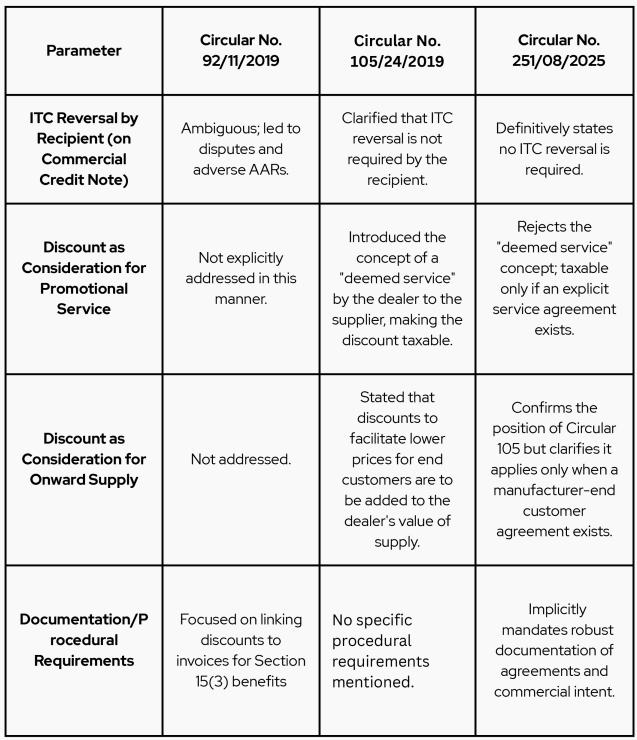
The Policy Evolution: From Confusion to Clarity
Circular No. 251 is not a standalone directive but the culmination of a multi-year policу
evolution marked by course corrections and a gradual shift towards pragmatism.
Understanding this journey is crucial to appreciating the circular’s significance.
The initial attempt at clarification came with Circular No. 92/11/2019-GST, which
addressed various sales promotion schemes. It correctly stated that
financial/commercial credit notes do not impact the supplier’s tax liability but left the
recipient’s ITC eligibility ambiguous, an omission that led to adverse advance rulings
and widespread confusion.
This was followed by the highly controversial Circular No. 105/24/2019-GST. This
circular introduced a legal fiction by suggesting that certain discounts given to dealers
could be treated as consideration for a deemed promotional service provided by the
dealer back to the supplier. This position was widely criticized by tax experts as an
overreach of executive power, legally unsound, and contrary to established commercial
realities, leading to significant industry pushback.
More recently, Circular No. 212/6/2024-GST was issued as an interim procedural
measure to operationalize the conditions of Section 15(3)(b) of the CGST Act. It
introduced the administratively burdensome requirement for suppliers to obtain
certificates from Chartered Accountants (CAs) or Cost Accountants (CMAS) to prove that
recipients had reversed their ITC, creating significant compliance friction and practical
difficulties for businesses.
Circular No. 251 represents a decisive course correction. It systematically dismantles
the problematic aspects of its predecessors. It directly resolves the ITC ambiguity of
Circular 92, unequivocally rejects the deemed service fiction of Circular 105, and
renders the procedural hurdles of Circular 212 redundant for discounts settled via
commercial credit notes. This trajectory reveals a significant shift in the CBIC’s policymaking philosophy-from an initially aggressive, revenue-centric approach to a more
pragmatic stance that prioritizes tax certainty and alignment with business practices.
The following table provides a comparative analysis of the CBIC’s evolving stance:
An Operational Blueprint for GST Compliance
The clarifications in Circular 251 necessitate a proactive review and potential overhaul
of existing business practices. The following blueprint provides actionable guidance for
ensuring compliance.
Contractual Redrafting and Best Practices
Businesses must immediately review and redraft their agreements with dealers,
distributors, and other supply chain partners to align with the circular’s principles. Key
clauses to incorporate include:
- A clear and unambiguous statement establishing the commercial relationship as
“principal-to-principal.” - Explicit definitions for all potential discounts (e.g., “volume rebate,” “prompt
payment discount,” “special trade discount”) with a clear declaration that they are
price adjustments and not consideration for any service. - A “severability” clause for promotional services. If any such services are
contemplated, they must be covered in a separate, distinct agreement that specifies
the scope of work, deliverables, and the consideration payable. - Clauses that address the handling of manufacturer-funded discounts for end
customers, ensuring the dealer is contractually informed of any underlying
agreements and their obligation to adjust the taxable value accordingly.
Accounting and Credit Note Management
The circular solidifies the strategic divide between two types of credit notes, requiring a
conscious decision-making process:
- Tax Credit Note (under Section 34): This reduces the supplier’s output tax liability
but requires the recipient to reverse their ITC. It must be linked to the original tax
invoice(s). Recent amendments have provided flexibility, allowing a single credit
note to be linked to multiple invoices, easing a long-standing compliance burden,
particularly for the FMCG sector. - Financial/Commercial Credit Note: This does not affect the original GST liability
for the supplier and, consequently, the recipient is not required to reverse ITC. It
offers greater commercial flexibility as it does not need to be linked to specific
invoices.
Businesses should develop a decision matrix to guide the choice of credit note,
considering factors such as the GST value of the discount, the compliance sophistication
of the recipient, the commercial importance of the relationship, and the supplier’s own
tax position.
Internal Controls and Audit Preparedness
Given the increased focus on documentation, robust internal controls are essential. This
includes:
- Developing a Formal Discount Policy: Create a comprehensive “Discount Policy
Manual” that is communicated across sales, marketing, and finance departments.
This manual should classify different types of discounts, outline the approval process,
and specify the documentation required for each. - Preparing for Audit Scrutiny: Tax audits will now focus on the substance and
documentation of discount arrangements. A checklist for audit preparedness should
include: - Maintaining a centralized repository of all supplier-dealer agreements and service
contracts. - Ensuring all credit notes are clearly labeled as either “Tax Credit Note” or
“Financial/Commercial Credit Note.” - Archiving all relevant correspondence (emails, letters) that supports the commercial
rationale for discounts, ensuring the language used does not inadvertently imply a
service obligation.
Sectoral Deep Dive: Impact and Case Studies
The principles of Circular 251 will have a varied but significant impact across different
industries, depending on their specific commercial practices.
Fast-Moving Consumer Goods (FMCG)
The FMCG sector is characterized by complex, multi-layered discount schemes designed
to drive volume through extensive distribution networks. A key industry challenge is
maintaining sacrosanct low price points (e.g., Rs. 5, Rs. 10), where benefits of cost
reductions are often passed on through increased grammage rather than price cuts.
The circular provides immense relief and strategic flexibility. Volume and target-based
discounts can now be confidently settled via commercial credit notes without triggering
ITC reversal for distributors, drastically simplifying compliance. The logic of the circular
also reinforces the position on promotional schemes like ‘Buy One Get One,’ treating
them as a single composite supply with full ITC eligibility, as clarified in Circular 92.
However, payments made to retailers for specific services like prime shelf space or instore displays will now clearly fall under the “taxable service” category, requiring a
separate agreement and a tax invoice from the retailer. This clarity allows FMCG
companies to design more aggressive and flexible trade schemes without the looming
fear of tax litigation.
Automotive Industry
The automotive sector operates on high-value transactions and a system of targetbased incentives, performance bonuses, and rebates paid by Original Equipment
Manufacturers (OEMs) to dealers. The taxability of these incentives has been a major
point of contention, as highlighted by the pre-GST CESTAT ruling in the Vipul Motors
case, which held such incentives to be non-taxable.
Circular 251 provides the clear framework under GST that was previously missing. An
incentive purely linked to achieving a sales volume target can be treated as a nontaxable trade discount settled via a commercial credit note. However, if an incentive is
linked to specific dealer actions, such as organizing test drive events or running a соbranded advertising campaign, it is unequivocally a consideration for a taxable service,
for which the dealer must issue a tax invoice to the OEM. Furthermore, fleet rebates
provided to dealers to facilitate sales to large corporate customers fall squarely under
the scenario where the discount must be added to the dealer’s transaction value. The
circular thus resolves the ambiguity that persisted in the GST era by establishing
clear, contract-based test.
Pharmaceutical Sector
The pharmaceutical industry’s promotional model is unique, centered on the distribution of “physician samples” free of cost to medical practitioners. This practice has been in direct conflict with Section 17(5)(h) of the CGST Act, which blocks ITC on goods disposed of as “free samples”. The industry has long argued that these are not consumer freebies but essential and regulated marketing tools integral to their business.
While Circular 251 does not directly address Section 17(5)(h), its underlying principles offer a new line of argument. The traditional tax view holds that the sample is a “gift” or “free sample,” mandating ITC reversal. However, leveraging the logic of the circular, a pharma company can now more strongly argue that distributing physician samples is part of its own business promotion, not a service rendered to the doctor. Since there is no “explicit agreement” for the doctor to provide a promotional service in return for the samples, the transaction should not be characterized as a supply of service. This does not automatically unblock the credit under the specific restriction of Section 17(5) (h), but it significantly strengthens the industry’s case that these are legitimate business promotion expenses, not gifts. This conceptual reframing could be pivotal in future representations to the GST Council for a specific carve-out for the pharma sector, a possibility that has been reported.
Conclusion and Forward Outlook
Circular No. 251/08/2025-GST is a landmark piece of subordinate legislation that brings long-awaited certainty and pragmatism to the GST treatment of post-sale discounts. It successfully balances the interests of revenue with the commercial realities of modern trade, resolving years of ambiguity and reducing the scope for litigation.
The key strategic imperatives for businesses are now clear: a critical need to overhaul commercial agreements to reflect the circular’s distinctions, a conscious and strategic approach to the use of different credit note mechanisms, and the maintenance of an impeccable, audit-ready trail of documentation to substantiate the nature of every discount.
Looking forward, while the circular clarifies the treatment of discounts, other complex areas in GST valuation remain. Issues surrounding related-party transactions, the valuation of composite and mixed supplies in specific contexts, and the treatment of non-monetary consideration continue to pose challenges. The clear and pragmatic approach demonstrated in Circular 251 provides a hopeful precedent that these remaining ambiguities may also be addressed through future policy interventions from the CBIC and the GST Council, paving the way for a more streamlined and certain GST regime.